


Klaviyo Email + SMS Strategy: The Ecommerce Setup That Drives Repeat Purchases

Email marketing is still a profit channel in ecommerce, but the “blast a newsletter” era is over. Today, ROI comes from sending the right message at the right moment to the right customer. That is why Klaviyo shows up in so many ecommerce stacks: it is built around customer events and automation, which makes personalization scalable.
This article breaks down Klaviyo in a more operational way. You’ll see what it is, how it helps ecommerce teams, which features actually matter, what to launch first, and how to keep improving results without turning your list into a discount-only audience.
1) Klaviyo, Explained Like a Store Owner
Klaviyo is a marketing automation platform designed for ecommerce brands that want more repeat purchases. It connects to your store, collects customer behavior signals, and lets you send email and SMS based on what people actually do—browse, add to cart, start checkout, buy, and come back (or don’t come back).
Basic email tools are mostly list-based: you pick a list and send a campaign. Klaviyo is event-driven: you build flows that trigger from customer actions. That makes it a natural fit for lifecycle marketing, including welcome journeys, abandonment recovery, post-purchase education, review requests, VIP journeys, and churn prevention.
If you want a simple mental model, think of Klaviyo as a “retention machine.” Once flows are built, they continue running—then you improve them gradually as you learn what your customers respond to.
2) Why Klaviyo Is a Popular Choice for Ecommerce Teams
Many brands are not losing money because they lack campaigns. They lose money because their timing is off and their messages are generic. Klaviyo’s biggest value is that it makes targeting and timing easier to execute.
It matches how shoppers behave
Shoppers move in loops, not straight lines. They browse, leave, compare, return, abandon, purchase, and buy again. Event-driven messaging fits this reality much better than periodic newsletters.
It makes “different messages for different buyers” realistic
Sending one email to everyone is easy—and usually expensive. Segmentation allows you to adapt your messaging to intent. Examples include:
- new subscribers who need trust-building, not urgency
- repeat buyers who respond to new arrivals and bundles
- inactive customers who need relevance to return
- category buyers who only want certain products
Flows keep working even when you are busy
Automation creates consistent revenue because it responds to intent instantly. That is difficult to replicate with manual campaigns alone.
SMS is there when you need speed
SMS can be powerful for high-intent reminders and time-sensitive moments. The best approach is to keep SMS selective and let email carry the longer-form education and storytelling.
3) Features That Move Revenue (Not Just “Nice-to-Haves”)
Klaviyo includes many capabilities, but ecommerce performance usually comes from a small subset. These are the ones that consistently matter.
Forms and list growth tools
List growth is not about collecting emails; it is about collecting buyers. Strong form strategy usually includes:
- a clear value offer (guide, quiz, bundle, perk), not only “10% off”
- low-friction sign-up (minimal fields upfront)
- preference capture later through follow-up emails
Flow builder
Flows are how you create a lifecycle system. You define triggers, timing, and content so messaging happens without manual work.
Behavior-based segments
The best segments are built from actions and purchase patterns. Examples:
- viewed a category 2+ times in 7 days
- abandoned checkout in the last 24 hours
- purchased once, but not again in 45 days
- high AOV customers with 2+ purchases
- discount code users (to control incentive strategy)
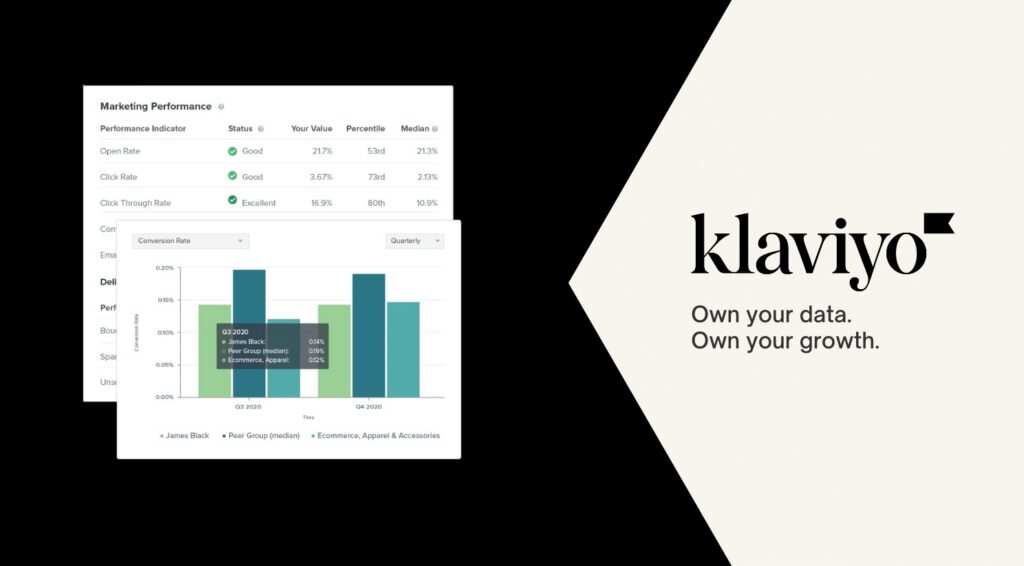
Revenue-focused reporting
Good reporting makes decisions easier. You want to know:
- which flows drive the most revenue per recipient
- which segments outperform the average
- whether repeat purchase rate is improving
- what content types lead to higher conversion
4) A “First 30 Days” Setup Plan
If you are new to Klaviyo, an effective approach is to launch a small number of flows, confirm they work, then expand. Here is a simple staged plan.
Week 1: Foundations
- connect your store data and confirm events are tracking correctly
- create one high-quality sign-up form (popup or embedded)
- define a basic segmentation structure (new, repeat, VIP, inactive)
Week 2: Revenue-critical flows
- welcome series to turn subscribers into first-time buyers
- cart + checkout recovery to capture high-intent shoppers
Week 3: Retention flow (the LTV builder)
- post-purchase education that helps customers get results quickly
- light cross-sell recommendations that improve outcomes (not random add-ons)
Week 4: Social proof and churn prevention
- review request after customers have time to experience the product
- win-back for 30/60/90-day inactive customers with curated recommendations
Many teams choose Klaviyo because this kind of system is straightforward to implement and iterate without stacking multiple tools.
5) Segmentation Templates You Can Copy
You do not need complex segmentation to outperform generic newsletters. Start with these practical segments and refine later.
| Segment | Definition (example) | What to send |
|---|---|---|
| New subscribers | Subscribed in last 14 days, no purchase | Brand promise, best sellers, proof, gentle nudge |
| First-time buyers | 1 purchase, last 45 days | Usage education, “what’s next,” companion products |
| Repeat buyers | 2+ purchases | New arrivals, bundles, early access, community stories |
| VIP | Top 10% by spend or AOV | Premium curation, priority support, exclusive perks |
| Inactive | No purchase in 60–90 days | Curated recommendations, proof refresh, limited incentives |
The point is not perfection. The point is sending fewer generic emails and more intent-matched messages.
6) Weekly Optimization: What to Look At (and What to Ignore)
Improvement is easier when you track a small number of metrics consistently.
Check flows first
- welcome: subscriber-to-buyer conversion
- abandonment: recovered revenue, click rate, unsubscribe rate
- post-purchase: second purchase rate and timing
- win-back: reactivation rate per inactivity window
Then evaluate campaigns
- revenue per recipient by segment
- engagement trends over time (not one campaign)
- deliverability signals and list health
Fast tests that often improve results
- rewrite subject lines to be clearer and more specific
- make emails more scannable (short paragraphs, bullets, clear CTA)
- adjust send timing based on actual customer behavior
- test one variable at a time to learn faster
7) Common Mistakes That Reduce LTV
- Too many promos: it trains people to wait and ignore.
- Weak post-purchase: if customers do not get results, they churn.
- Generic list behavior: one message for all customers underperforms.
- Discount as default: margin drops, and trust can weaken over time.
- Ignoring deliverability: poor list health quietly lowers ROI.
FAQ
Is Klaviyo worth it for a small store?
It can be, especially if you build a few high-impact flows. Welcome, abandonment, and post-purchase education often produce meaningful returns even with a smaller list.
Do I need SMS on day one?
No. Start with email. Add SMS only when you have a clear use case (high-intent reminders, time-sensitive updates) and keep frequency tight.
How quickly can I see results?
Many stores see early gains as soon as abandonment and welcome flows are live. Retention gains from post-purchase systems compound over time.
What is the most important retention milestone?
The second purchase. That is why post-purchase education and “what’s next” recommendations matter so much.
How do I avoid sounding spammy?
Reduce promo frequency, increase helpful content, segment your audience, and make sure each flow has a clear purpose tied to the customer journey.
Final Thoughts
Klaviyo works best when you stop thinking in campaigns and start thinking in customer journeys. Build a few flows that guide customers at high-intent moments, use segmentation to keep relevance high, and improve performance with weekly tracking rather than random changes.
If you want a platform that makes ecommerce personalization and automation feel doable, you can explore Klaviyo and start with a simple lifecycle setup—then expand into deeper segmentation and smarter retention messaging as your store scales.
Building retention revenue with Klaviyo becomes much more consistent when you combine a clean flow foundation, a small set of high-value segments, and reporting that ties every message back to repeat purchases and long-term customer value.